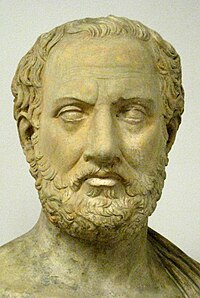
Our constitution does not copy the laws of neighboring
states; we are rather a pattern to others than imitators ourselves. Its
administration favors the many instead of the few; this is why it is called a
democracy. If we look to the laws, they afford equal justice to all in their
private differences; if to social standing, advancement in public life falls to
reputation for capacity, class considerations not being allowed to interfere
with merit; nor again does poverty bar the way, if a man is able to serve the
state, he is not hindered by the obscurity of his condition.
The freedom which we enjoy in our government extends also to
our ordinary life. There, far from exercising a jealous surveillance over each
other, we do not feel called upon to be angry with our neighbor for doing what
he likes, or even to indulge in those injurious looks which cannot fail to be
offensive, although they inflict no positive penalty. But all this ease in our
private relations does not make us lawless as citizens. Against this fear is
our chief safeguard, teaching us to obey the magistrates and the laws,
particularly such as regard the protection of the injured, whether they are
actually on the statute book, or belong to that code which, although unwritten,
yet cannot be broken without acknowledged disgrace.
If we turn to our military policy, there also we differ from
antagonists. We throw open our city to the world, and never by alien acts
exclude foreigners from any opportunity of learning or observing, although the
eyes of an enemy may occasionally profit by our liberality; trusting less in
system and policy than to the native spirit of our citizens; while in
education, where our rivals from their very cradles by a painful discipline
seek after manliness, at Athens we live exactly as we please, and yet are just
as ready to encounter every legitimate danger. And yet if with habits not of
labor but of ease, and courage not of art but of nature, we are still willing
to encounter danger, we have the double advantage of escaping the experience of
hardships in anticipation and of facing them in the hour of need as fearlessly
as those who are never free from them.
We cultivate refinement without extravagance and knowledge
without effeminacy; wealth we employ more for use than for show, and place the
real disgrace of poverty not in owning to the fact but in declining the
struggle against it. Our public men have, besides politics, their private
affairs to attend to, and our ordinary citizens, though occupied with the
pursuits of industry, are still fair judges of public matters; for, unlike any
other nation, regarding him who takes no part in these duties not as
unambitious but as useless, we Athenians are able to judge at all events if we
cannot originate, and instead of looking on discussion as a stumbling-block in
the way of action, we think it an indispensable preliminary to any wise action
at all.
Again, in our enterprises we present the singular spectacle
of daring and deliberation, each carried to its highest point, and both united
in the same persons; although usually decision is the fruit of ignorance,
hesitation of reflection. But the palm of courage will surely be adjudged most
justly to those, who best know the difference between hardship and pleasure and
yet are never tempted to shrink from danger.
In generosity we are equally singular, acquiring our friends
by conferring not by receiving favors. Yet, of course, the doer of the favor is
the firmer friend of the two, in order by continued kindness to keep the
recipient in his debt; while the debtor feels less keenly from the very
consciousness that the return he makes will be a payment, not a free gift. And
it is only the Athenians who, fearless of consequences, confer their benefits
not from calculations of expediency, but in the confidence of liberality.
In short, I say that as a city we are the school of Hellas. And
that this is no mere boast thrown out for the occasion, but plain matter of
fact, the power of the state acquired by these habits proves. For Athens alone
of her contemporaries is found when tested to be greater than her reputation,
and alone gives no occasion to her assailants to blush at the antagonist by
whom they have been worsted, or to her subjects to question her title by merit
to rule.
Rather, the admiration of the present and succeeding ages
will be ours, since we have not left our power without witness, but have shown
it by mighty proofs; and far from needing a Homer for our panegyrist, or other
of his craft whose verses might charm for the moment only for the impression
which they gave to melt at the touch of fact, we have forced every sea and land
to be the highway of our daring, and everywhere, whether for evil or for good,
have left imperishable monuments behind us.
Such is the Athens for which these men, in the assertion of
their resolve not to lose her, nobly fought and died; and well may very one of
their survivors be ready to suffer in her cause. Indeed if I have dwelt at some
length upon the character of our country, it has been to show that our stake in
the struggle is not the same as theirs who have no such blessings to lose. For the
Athens that I have celebrated is only what the heroism of these and their like
have made her, men whose fame, unlike at of most Hellenes, will be found to be
only commensurate with their deserts.
But none of these allowed either wealth with its prospect of
future enjoyment to unnerve his spirit, or poverty with its hope of a day of
freedom and riches to tempt him to shrink from danger. No, holding that
vengeance upon their enemies was more to be desired than any personal
blessings, and reckoning this to be the most glorious of hazards, they joyfully
determined to accept the risk, to make sure of their vengeance and to let their
wishes wait; and while committing to hope the uncertainty of final success, in
the business before them they thought fit to act boldly and trust in
themselves. Thus choosing to die resisting, rather than to live submitting,
they fled only from dishonor, but met danger face to face, and after one brief
moment, while at the summit of their fortune, escaped, not from their fear, but
from their glory.
So died these men as became Athenians. You, their survivors,
must determine to have as unaltering a resolution in the field, though you may
pray that it may have a happier issue. And not contented with ideas derived
only from words of the advantages which are bound up with the defence of your
country, though these would furnish a valuable text to a speaker even before an
audience so alive to them as the present, you must yourselves realize the power
of Athens, and feed your eyes upon her from day to day, till love of her fills
your hearts; and then when all her greatness shall break upon you, you must
reflect that it was by courage, sense of duty, and a keen feeling of honor in
action that men were enabled to win all this, and that no personal failure in
an enterprise could make them consent to deprive their country of their valor,
but they laid it at her feet as the most glorious contribution that they could
offer.
For this offering of their lives made in common by them all
they each of them individually received that renown which never grows old, and
for a sepulchre, not so much that in which their bones have been deposited, but
that noblest of shrines wherein their glory is laid up to be eternally
remembered upon every occasion on which deed or story shall fall for its
commemoration. For heroes have the whole earth for their tomb; and in lands far
from their own, where the column with its epitaph declares it, there is
enshrined in every breast a record unwritten with no tablet to preserve it,
except that of the heart.
These take as your model, and judging happiness to be the
fruit of freedom and freedom of valor, never decline the dangers of war. For it
is not the miserable that would most justly be unsparing of their lives; these
have nothing to hope for: it is rather they to whom continued life may bring
reverses as yet unknown, and to whom a fall, if it came, would be most
tremendous in its consequences. And surely, to a man of spirit, the degradation
of cowardice must be immeasurably more grievous than the unfelt death which
strikes him in the midst of his strength and patriotism.
Tucídides, Historia de la Guerra del Peloponeso


No hay comentarios:
Publicar un comentario